By VirtuStack • July 2026 • 7 min read
Two firms are chasing the same line. Only one gets it. And the reason has almost nothing to do with who’s the better salesperson.
Sound unfair? Keep reading.
Both firms are good. Both have decades of experience. Both know the territory cold. But when the principal sits down to decide, one firm looks like a safe bet and the other looks like a question mark. Same skills. Different outcome.
Let me walk you through how that happens.
The Parable: Two Firms, One Open Territory
A principal has an open territory. They need a rep firm to carry the line. Word gets out, and two firms raise their hands.
Call them Firm A and Firm B.
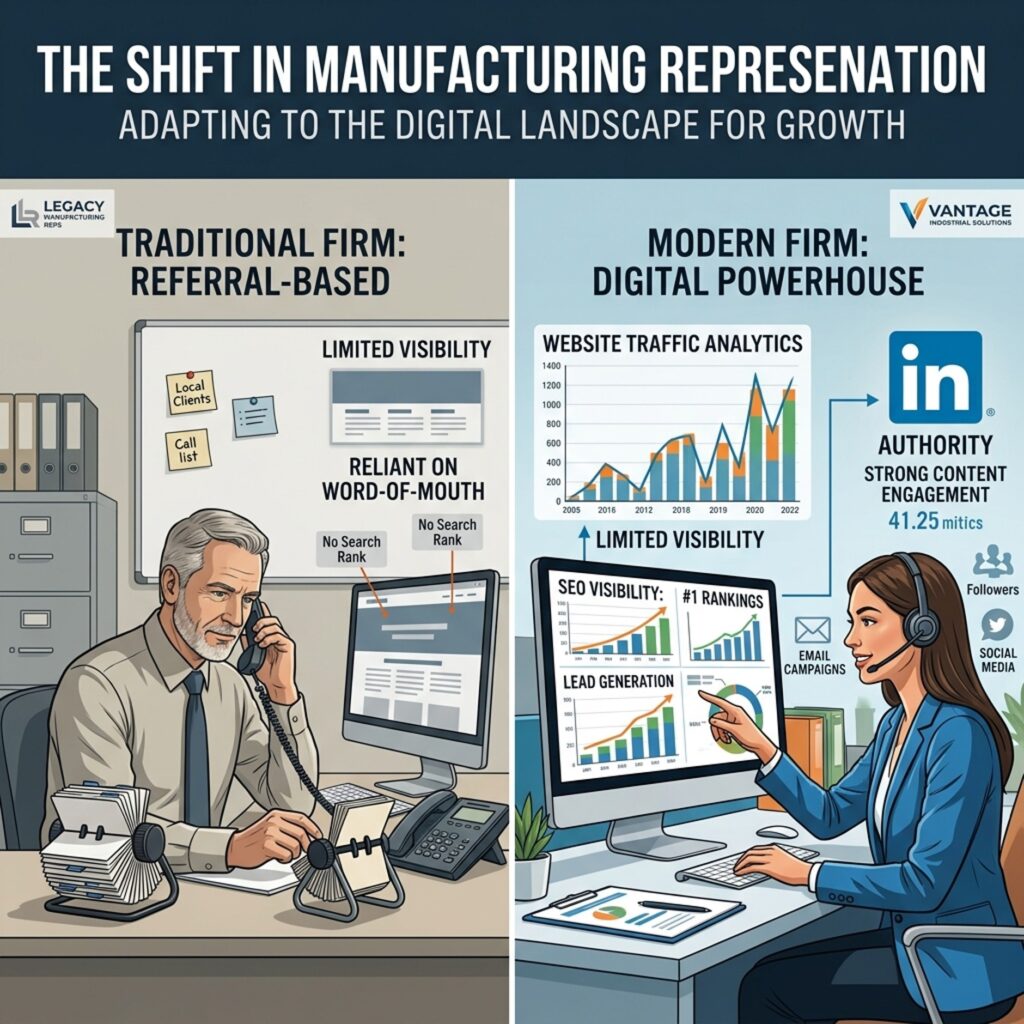
Firm A runs on referrals. They’re great at what they do. Their people are sharp, their relationships run deep, and their close rate is strong. When someone calls, they deliver. The problem? You have to already know them to call them. Their pipeline lives inside a handful of relationships and a busy trade show calendar. Nothing wrong with that on the surface. It’s how the industry has always worked.
Firm B runs on referrals too. Same skills, same close rate. But Firm B added something Firm A didn’t. They built a content engine. A steady stream of technical blogs, case studies, and LinkedIn posts that speak directly to the engineers and buyers in their space. They show up in search. They show up in feeds. They show up before anyone even makes a call.
Now the principal starts doing homework.
They Google both firms. Firm A has a thin website and a listing or two. Firm B has articles that answer real buyer questions, case studies with numbers, and a LinkedIn page that’s clearly alive. They check LinkedIn next. Firm A’s last post was eleven months ago. Firm B posts every week, and engineers actually comment.
Put yourself in the principal’s chair. Which firm feels like a partner who will grow the line? Which one feels like a firm that’s coasting on the past?
That’s the whole parable. Same talent. Different visibility. The visible firm wins.
What Principals Actually Check Before Awarding a Territory
Here’s the part nobody says out loud. Before a principal ever picks up the phone, they’ve already formed an opinion. And they formed it online.
You might think the decision comes down to the meeting. The pitch. The handshake. It doesn’t. By the time you’re in the room, half the decision is already made. So what are they checking?
- Your Google results. They search your firm name. Then they search the products and problems your buyers care about. If you don’t show up, you look small.
- Your LinkedIn presence. They look at your company page and your people. An active feed signals momentum. A dead feed signals a firm that stopped growing.
- Your case studies. They want proof you’ve done this before, with real outcomes. Vague claims don’t count. Numbers do.
- Your proof assets. Testimonials, spec sheets, technical guides, landing pages built for their kind of buyer. These tell a principal you understand the sale.
Notice something? Every single one of these is content. Not charm. Not history. Content.
Firm A had none of it. Firm B had all of it. And that gap decided the line before either firm walked in.
Think about your own firm for a second. If a principal searched you today, what would they find? Be honest. What they find is what they believe.
The Compounding Effect of 12 Months of Consistent Content
Here’s where it gets good. One blog post won’t win you a territory. Neither will one LinkedIn update. But twelve months of steady content? That changes everything.
Content compounds. That’s the whole secret.
In month one, you publish a technical article. A few people read it. Feels like shouting into the wind, honestly. In month three, that same article starts ranking in search. In month six, a buyer finds it on their own and reaches out. You didn’t chase them. They came to you.
That’s what Firm B built. Not overnight. Post by post, month by month.
Let me show you what a year of consistency actually does:
- Traffic grows. Every article you publish is another door into your firm. Twelve months of articles means twelve months of doors, all open at once.
- Trust builds. Buyers who read your content start to trust you before they ever talk to you. You become the firm that “gets it.”
- Inbound leads arrive. Instead of only chasing, you start receiving. Prospects who found you through search or LinkedIn show up warmer and closer to buying.
And here’s the compounding part. Firm A starts from zero every single month. Firm B starts from everything they’ve already built. That old article from month two is still working. Still ranking. Still bringing in readers while the team sleeps.
That’s the difference between a firm that markets when it has time and a firm that runs a system. One is always starting over. The other is always ahead.
Twelve months from now, you’ll wish you’d started twelve months ago.
How VirtuStack Builds Your Content Engine
You don’t have to become Firm B on your own. That’s the good news.
VirtuStack builds this exact system for manufacturers’ reps and industrial sales firms. No guesswork. No “post when you feel like it.” A structured engine that runs on four simple steps:
- Roadmap. We turn your goals into a clear plan that connects where you are now to real pipeline growth.
- Messaging Strategy. We sharpen your positioning so your content and your sales conversations say the same strong thing.
- Essential Content. We create the technical blogs, case studies, and proof assets that make principals trust you and buyers act.
- End-to-End Campaigns. We run search, LinkedIn, email, and retargeting as one connected system, then report on what’s working.
That’s the whole machine. Built specifically for firms like yours.
So back to the two firms. One waited for the phone to ring. The other made sure the principal already knew their name. Both were good. Only one had a content engine.
The next open territory is coming. Which firm do you want to be?
Ready to make sure the next principal who searches your firm finds a partner, not a question mark?