By VirtuStack • July 2026 • 8 min read
Your booth cost went up again. And the aisle traffic? Thinner than last year. You already feel it, don’t you?
For years, trade shows were the center of the plan. You booked the space, packed the samples, shook the hands, and came home with a stack of business cards. That was the system. But the math has changed. And if you run a rep firm in 2026, the old spreadsheet no longer adds up.
This isn’t a call to quit trade shows. It’s a call to look at the numbers honestly and build a smarter mix. Let’s do the math together.
The Costs Are Climbing While the Crowds Are Shrinking
Start with what you’re paying.
Booth space, drayage, electrical, carpet, shipping, hotel blocks, flights, per diems, and the days your best engineers spend off the floor. Add it up and one mid-tier show can run you $30,000 to $75,000. A larger national show? Six figures, easy.
Now look at what you’re getting back.
Walk-in traffic at industrial shows has been sliding for years. Buyers research online before they ever step onto a show floor. Many decision-makers send a junior person to scout, or skip the trip entirely. The people you most want to meet are the hardest ones to catch at your booth.
So here’s the uncomfortable question: you’re paying more every year to reach fewer of the right people.
That’s not a knock on trade shows. It’s just the reality of the 2026 buyer. They gather information differently now. They compare vendors on their laptop before lunch. By the time they’d meet you at a booth, they’ve already narrowed the list.
The show still has value. But it can’t carry your pipeline alone anymore.
How to Measure What a Trade Show Actually Delivers
Most rep firms measure trade shows by feel. “It was a good show.” “We had a lot of conversations.”
Feelings aren’t a metric. Cost-per-opportunity is.
Here’s how to run the number for any channel:
- Add up the total cost of the show. Include booth, travel, staff time, and materials.
- Count the real opportunities it created. Not badges scanned, actual qualified conversations that entered your pipeline.
- Divide the cost by the opportunities. That’s your cost-per-opportunity.
A quick example. Say a show costs you $50,000 and produces 20 genuine opportunities. That’s $2,500 per opportunity. Now be honest about how many of those 20 were real buyers versus tote-bag collectors.
Then run the same math on your digital channels.
A LinkedIn campaign targeting plant engineers might cost $5,000 a month and generate 15 qualified conversations. That’s roughly $333 per opportunity. A search campaign built around the exact terms your buyers type, “explosion-proof flow meter supplier,” say, catches people already looking to buy. That intent makes each opportunity cheaper and warmer.
Put the numbers side by side:
- Trade show: high cost, lumpy timing, once or twice a year.
- LinkedIn: steady cost, builds authority, reaches decision-makers directly.
- Search: captures active demand the moment a buyer starts looking.
You don’t need a fancy dashboard to start. A single spreadsheet with three columns, cost, opportunities, cost-per-opportunity, will tell you more than any post-show gut check.
Measure every channel the same way. Then you can compare apples to apples.
The Hybrid Model: Shows for Relationships, Digital for Pipeline
Here’s where a lot of rep firms get it wrong. They treat this like a choice. Shows or digital. Old way or new way.
It’s not a choice. It’s a division of labor.
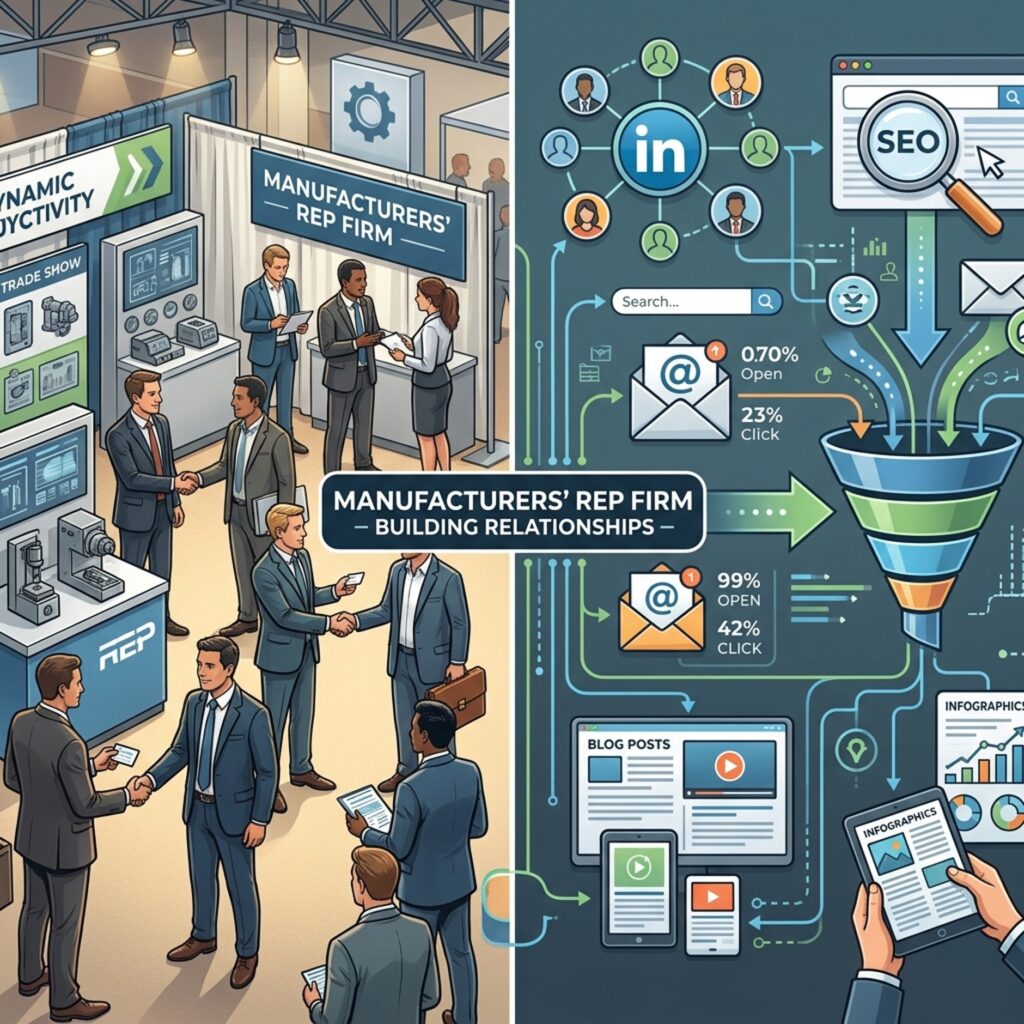
Trade shows are good at one thing above all: relationships. There’s no digital replacement for a firm handshake, a live demo, or dinner with a key account. Shows build trust fast and put faces to names. That’s real. Keep that.
But relationships aren’t a pipeline. A pipeline is a steady flow of new opportunities coming in week after week, not a spike every March and a drought until fall.
So split the jobs:
- Use trade shows to deepen relationships. Reconnect with existing accounts. Run demos. Meet the people your digital channels warmed up all year.
- Use LinkedIn to build authority. Post technical insights that prove your engineers know their stuff. Stay visible to decision-makers between shows.
- Use search to catch active demand. Rank for the problems your buyers search when they’re ready to specify a solution.
- Use email to nurture the middle. Keep warm leads warm until they’re ready to talk.
Shows create the spark. Digital keeps the fire going all year.
That’s the model VirtuStack builds for rep firms: a structured system where every channel has a job, and no single channel carries the whole load. You stop depending on referrals and one big show. You build a pipeline you can predict.
Think of it this way. The show fills the room. Digital keeps the room full the other 360 days.
How to Turn One Trade Show Into 90 Days of Content
Here’s the part most firms leave on the table. You spend $50,000 on a show, and the value evaporates the day you tear down the booth.
It shouldn’t. One show can feed your content for a full quarter.
You already gathered the raw material. The questions buyers asked. The problems they described. The demos you ran. The conversations on the floor. That’s a goldmine of content, you just have to mine it.
Here’s a simple 90-day plan to stretch one show across three months:
- Record the questions. During the show, jot down every question a prospect asks. Each one is a future blog or post.
- Film short demos. Grab 60-second clips of your product in action. Phone video is fine.
- Photograph the booth and the team. You’ll use these across posts and emails.
- Interview one happy customer. A five-minute chat becomes a case study.
Then space it out:
Days 1–30: The recap and the momentum
- Publish a “top 5 questions we heard at the show” blog post.
- Post the demo clips on LinkedIn, one per week.
- Send a follow-up email to everyone you met with a link to the recap.
Days 31–60: The deep dives
- Turn each big question into its own technical blog post.
- Write LinkedIn posts that expand on the trends you saw on the floor.
- Build a case study from that customer interview.
Days 61–90: The proof and the pull
- Share the finished case study across email and LinkedIn.
- Publish a “what we learned” post that positions your firm as the expert.
- Point search-optimized content at the exact problems buyers described.
Notice what happened. One event became a dozen blog posts, twenty LinkedIn posts, three emails, and a case study. The people who never made it to your booth still hear from you. The people who did stay engaged for months.
That’s how you get more from what you already paid for.
Don’t let the show end when the booth comes down.
The 2026 Math Is Simple
Trade shows cost more and reach fewer of the right people. That’s not going to reverse. But shows still do something digital can’t: they build real relationships in real life.
So keep the shows. Just stop asking them to be your whole pipeline.
Run the cost-per-opportunity math on every channel. Let shows do relationships. Let LinkedIn, search, and email do pipeline. And squeeze 90 days of content out of every event you attend.
Do that, and you stop hoping for a good show. You start building a system that produces opportunities every single week.
That’s the math that works in 2026.
Ready to build a marketing system that doesn’t live or die by the next trade show?